
Key takeaways
- Fires are grouped into six classes, A to F, according to what is burning; Class E covers electrical equipment [1].
- No single type of extinguisher can be used on every type of fire [2].
- An ABC dry powder extinguisher covers Classes A, B and C [3].
- Extinguishers should be no more than 20 metres from any potential fire location [3].
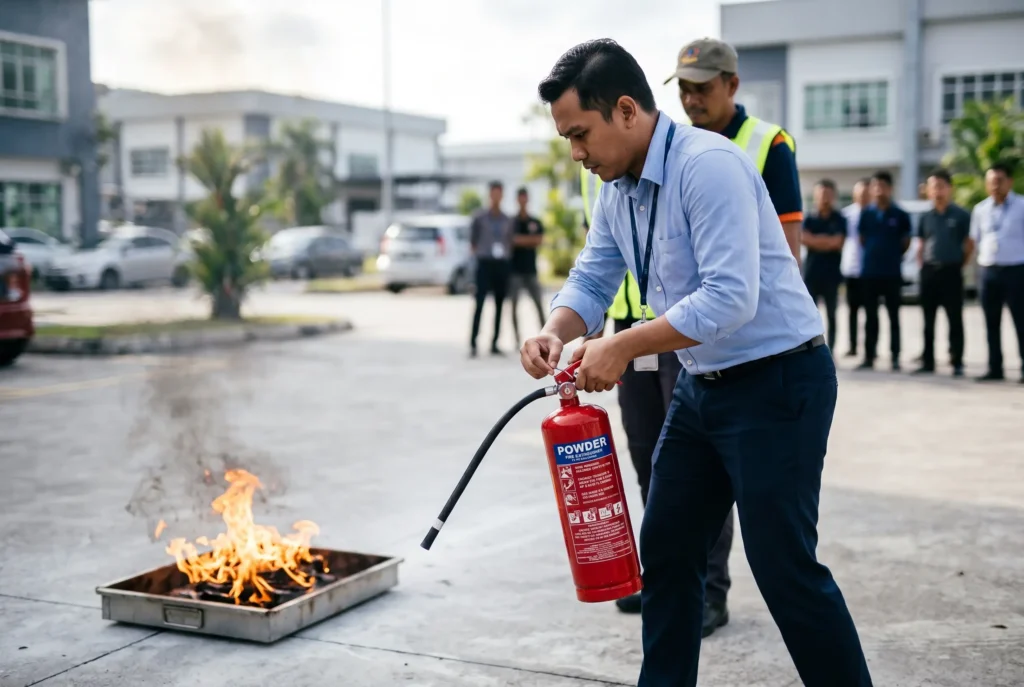
Using the wrong extinguisher can be ineffective or even dangerous. This guide explains the classes of fire used in Malaysia, the main types of extinguisher and how to choose between them.
What are the classes of fire?
A Malaysian university fire extinguisher guideline groups fires into six classes and lists the suitable extinguishers for each [1]:
| Class | What is Burning | Suitable extinguishers |
|---|---|---|
| A | Solid combustible materials, except metals | Water, foam, dry powder |
| B | Flammable liquids | Foam, dry powder, CO2 |
| C | Gases or vapours | Dry powder, CO2 |
| D | Metals | Dry powder |
| E | Electrical equipment | Dry powder, CO2 |
| F | Cooking oil or fat | Dry powder, CO2 |
What does each type of extinguisher do?
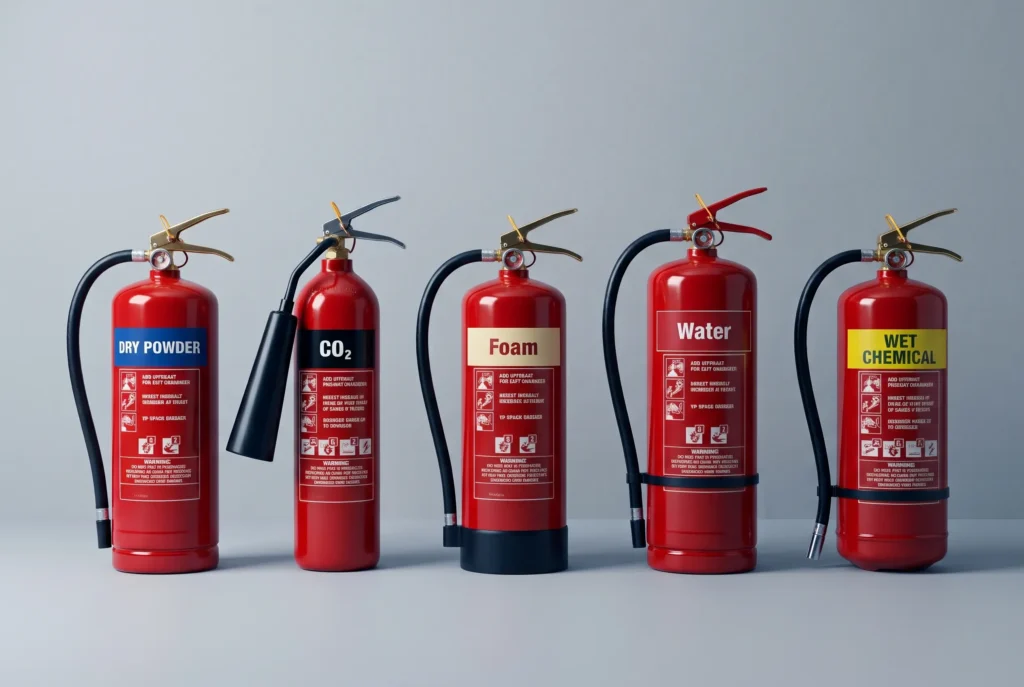
Water. For Class A fires only. Water is an electrical conductor, so a water extinguisher is unsuitable where the fire involves an electrical supply [2].
Foam. For Class A and B fires [2].
Dry powder. The most versatile type, covering Classes A, B and C, and electrical fires [2]. In Malaysian buildings, the ABC dry powder extinguisher suits Classes A, B and C, and sometimes E [3]. Its drawbacks: visibility is reduced when it is discharged, clean-up is costly because it leaves a lot of residue, and the powder can corrode electrical equipment [2].
Carbon dioxide (CO2). Most suitable for Class B and electrical fires [2]. CO2 is an asphyxiant gas, so it should not be used in confined spaces; the horn can cause frost burns if touched; and it offers no protection against re-ignition [2].
Wet chemical. Most suitable for Class F fires such as deep fat fryers [2]. It is not suitable for electrical fires, and the solution can irritate the skin and eyes [2].
Which extinguisher suits a kitchen or an electrical room?
For cooking oil fires (Class F), the UK Fire Protection Association describes wet chemical extinguishers as the most suitable, for use on deep fat fryers [2], while the Malaysian guideline lists dry powder and CO2 for Class F [1]. Wet chemical extinguishers are available in Malaysia [4].
For electrical equipment (Class E), both CO2 and dry powder are listed as suitable [1]. Because dry powder can corrode electrical equipment and leaves residue [2], CO2 is the cleaner choice where equipment must be protected.
How do you recognise a compliant extinguisher in Malaysia?
A compliant portable extinguisher has a red cylinder following the MS 1539 Part 1 colour code, a label with clear text and pictograms, and the SIRIM product certification mark on the label [5]. Extinguishers in commercial premises also carry a BOMBA licence sticker, renewed every year [6].
Where should extinguishers be placed?
- No more than 20 metres from any potential fire location, under MS 1539-3 [3].
- If an extinguisher is out of direct view, its position must be shown by a prominent sign [3].
- Extinguishers are required in all categories of buildings under UBBL By-law 227 [3].
- A portable extinguisher weighs no more than 20 kg so that it can be carried and used effectively [3].
Frequently asked questions
No. No single type of extinguisher can be used on all types of fires.
The ABC dry powder extinguisher, which suits Classes A, B and C, and sometimes E.
Yes. Extinguishers used in a commercial location need a BOMBA licence, renewed every year after servicing and inspection.
Sources
- UTHM OSHE, Garis Panduan Penyediaan Alat Pemadam Api, GP.005 Rev.2, 2024, Jadual 2. https://oshe.uthm.edu.my/images/Documents/Garis_Panduan/GP.005_REV.2_2024.pdf
- Fire Protection Association (UK), “What fire extinguisher to use?”. https://www.thefpa.co.uk/news/fire-safety-advice-and-guidance/what-fire-extinguisher-to-use-
- Malay Mail, “From hose reels to risers: Fire safety systems every condo resident should know”, 26 January 2026. https://www.malaymail.com/news/malaysia/2026/01/26/from-hose-reels-to-risers-fire-safety-systems-every-condo-resident-should-know/204632
- 119 Fire Control, “Fire Extinguisher License Renewal Malaysia”, 5 November 2025. https://www.119firecontrol.com/fire-extinguisher-license-renewal-malaysia.html
- Era Harvest Supply & Engineering, “How often do fire extinguishers need servicing in Malaysia?”, 7 October 2026. https://eraharvest.com/fire-extinguisher-servicing-malaysia/
- Fire Fighter Industry, “Everything You Need To Know About Bomba License”. https://www.firefighter.com.my/blogs/news/everything-you-need-to-know-about-bomba-license